
How It Works for Any Country
One box in the send window. Customers you never switch on keep getting your PDF and a link.
Tick
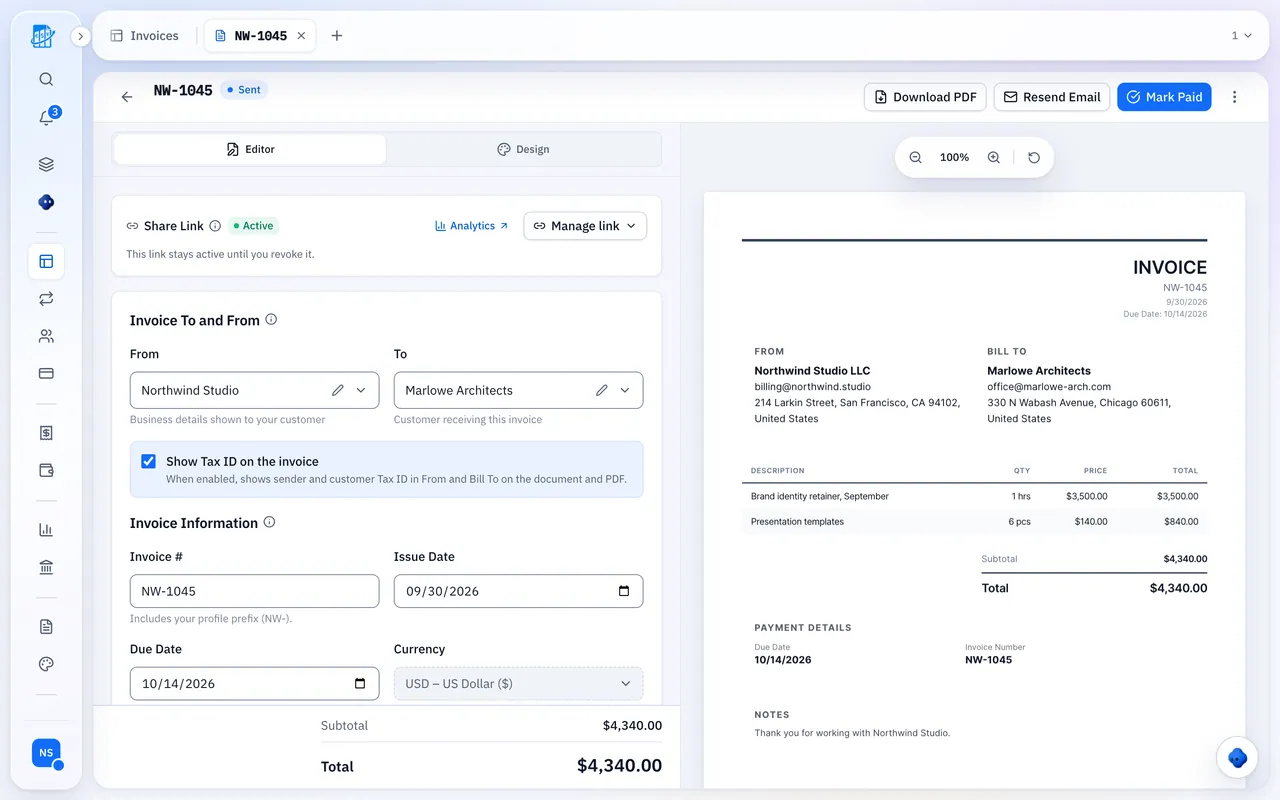
Tick Send as e-invoice when you send. One line under the box shows what is missing for the chosen format, or that it is ready.
Choose
Pick ZUGFeRD or XRechnung for Germany, or EN 16931 as UBL or CII for other countries. The customer keeps the choice for next time.
Check
The file is checked with the KoSIT validator, which has its own EN 16931 rules for UBL and CII. If it finds an error, nothing is sent.
Send
The file goes out with your normal email. If you and your customer are both in a country that needs an accredited provider, a notice says QuickBilling cannot send there yet.
XRechnung, ZUGFeRD or EN 16931?
All three are built on the European standard EN 16931. XRechnung is the German version; plain EN 16931 has no national rules on top.
- XRechnung (XML, CII or UBL): for German public authorities and German businesses that ask for it
- ZUGFeRD (a PDF with the XML inside): for German customers who want one readable file, technically the same as Factur-X
- EN 16931 (XML, UBL or CII): for customers outside Germany whose software reads e-invoices; ask them which syntax they take
- Each file is stored with the invoice, and XML files go out next to your normal PDF
Which File for Which Country
Your customer’s country and software decide. The German rules are on the e-invoicing page.
Germany
XRechnung or ZUGFeRD. Businesses in Germany must be able to receive e-invoices since 1 January 2025.
Other EU countries
EN 16931 as UBL or CII, by email, when your customer accepts e-invoices that way.
UK and elsewhere
EN 16931 by email when your customer asks for it, for example a UK business ahead of the 2029 rules.
Accredited-provider countries
Belgium, France, Slovakia, Croatia, Greece, Oman, Norway and the UAE: between two local businesses, QuickBilling shows a notice instead of sending.
E-invoicing is free on every plan, for every format.
What Is Included
Free on Free, Premium and Unlimited.
- XRechnung 3.0 as CII or UBL
- ZUGFeRD in the EN 16931 profile
- EN 16931 as UBL or CII, with no national version on top
- A check with the KoSIT validator before sending
- One line under Send as e-invoice that shows what is missing
- A notice for countries that need an accredited provider
- Reading XRechnung, UBL, CII and ZUGFeRD files into expenses
- On every plan, through the app and the REST API
Dates Worth Knowing
Germany
Every business must be able to receive e-invoices since 1 January 2025; issuing them becomes the rule in 2027 and 2028.
Belgium
Structured e-invoices between Belgian businesses liable to VAT have been compulsory since 1 January 2026.
France
All businesses must receive e-invoices from 1 September 2026; small and micro businesses issue them from 1 September 2027, through a plateforme agréée.
United Kingdom
VAT-registered businesses must issue and receive VAT invoices as e-invoices from 1 April 2029.
Sources, read on 17 November 2026: BMF FAQ (Germany), einvoice.belgium.be, impots.gouv.fr, gov.uk e-invoicing roadmap, UAE Ministry of Finance (accredited providers). A summary, not tax advice: QuickBilling organises and drafts your invoices, and your tax adviser decides what applies to you.
E-Invoicing by Country: FAQs
Short answers to what people ask before sending abroad.
What Is EN 16931?
The European standard for e-invoices. It defines the invoice data and two XML syntaxes, UBL and CII. National formats such as XRechnung add their own rules on top.
Which Format Do I Send to a Customer Outside Germany?
Ask your customer which syntax their software reads, UBL or CII, and choose EN 16931 in that syntax. If they do not read e-invoices, send the normal PDF.
Is EN 16931 the Same as Peppol?
No. Peppol BIS Billing 3.0 is built on EN 16931 but travels over the Peppol network through an access point. QuickBilling makes the EN 16931 file and emails it; it is not connected to Peppol.
Can I Send E-Invoices to Customers in Belgium or France?
Yes, as an EN 16931 file by email when your customer accepts it. Invoices between two businesses in Belgium or in France go through an accredited provider or a plateforme agréée, which QuickBilling is not connected to.
Does QuickBilling Support E-Invoicing in the UAE?
No. In the UAE, e-invoices go through an Accredited Service Provider listed by the Ministry of Finance, and QuickBilling is not one. Between two UAE businesses it shows a notice.
Does QuickBilling Check My Country’s Rules?
It checks the file against EN 16931, and against XRechnung for the German formats, with the KoSIT validator. It does not check national tax rules; ask your tax adviser.
Is E-Invoicing Free?
Yes, on every plan and for every format.